
Two weeks in the field just before Christmas may sound like some soldiers’ worst nightmare, but the dozen Army personnel who deployed to Namibia in late November might argue otherwise.
These Regular and Reserve soldiers from the RAC, RA, REME and RAMC came together in Windhoek on November 26th, ahead of the Royal Scots Dragoon Guards-led Exercise Eagles’ Endurance. The exercise required all of the patrolling skills, fieldcraft and trade development you’d expect of any other cavalry and attached arms exercise, but with one key difference. The soldiers were in fact to be patrolling on two wheels, in an arduous, 1,600-kilometre motorcycle expedition across Namibia’s remote northern territories, before descending the infamous Namib desert.
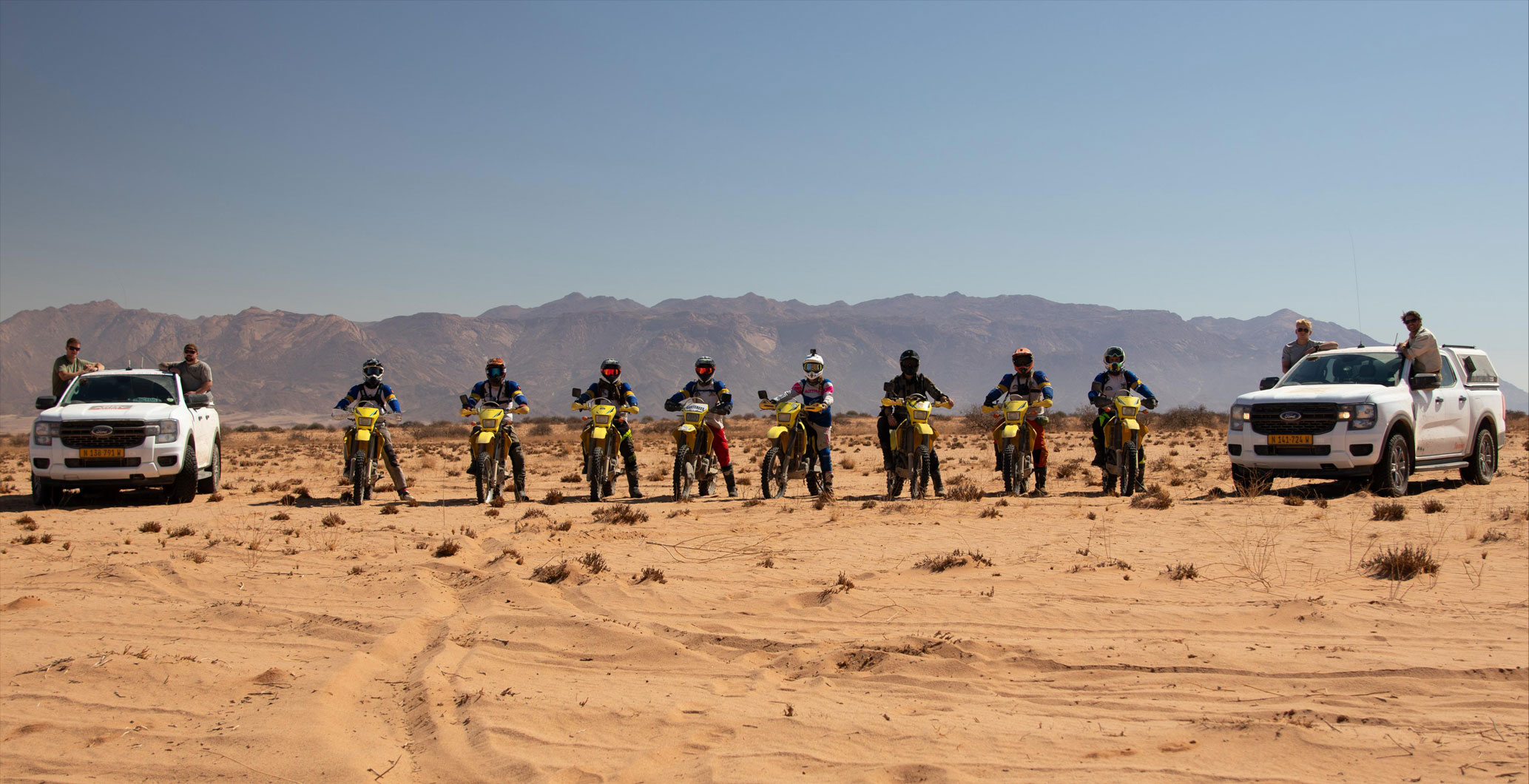
The exercise was the latest in a long line of military overlanding expeditions, and was overseen by Army Motorised Adventure, a group which aims to promote and support motorised adventure expeditions within the British Armed Forces.
After completing the pre-deployment preparation in the capital, the first few days formed an acclimatisation period of gentle riding on established dirt roads, with training serials tailored to the expedition. The team were taught ‘actions on’ in the event of a medical emergency, and how to conduct basic servicing and repairs, such as tyre changes, on their motorcycles.

As confidence grew, the terrain and navigation became progressively more difficult, with deep sandy tracks and winding rocky climbs thrown in. The extreme heat and presence of wild animals threw in an extra layer of complexity for the team to contend with and mitigation was put in place to manage these risks – regular hydration stops were planned into the schedule and the riders took it in turns to cycle through two support 4x4s to cool down and rest.

As the expedition pushed north, the desert scenery became interspersed by deep gorges, in which the elephant threat significantly increased. It was in one of these gorges that the troops’ teamwork was really put to the test, when one of the support vehicles became stuck in a swamp, precariously balanced, and at risk of tipping over. Forming a chain, the soldiers unloaded the vehicle, before recovering it following the standard operating procedures that they have learned throughout their military careers.

Lt Rob Boylin, Royal Scots Dragoon Guards, was leading the exercise. He explained why training on motorcycles would benefit the troops:
“Exercise Eagles’ Endurance was designed to promote and develop the core skills required of a soldier, focusing on leadership, patrolling, navigation, fieldcraft, maintenance, recovery and medical skills by testing our people in an unconventional and arduous environment. As a Light Cavalry soldier, the skills required of motorised adventure align with conventional training and operational requirements. In Namibia, we took exactly the same patrolling, navigation, maintenance, and recovery techniques that we use on our HMTVs and transplanted them on to two wheels, developing our skills and absolutely proving the value this type of training.
“This is exactly the type of role-specific activity that the Army should be adopting; No other style of non-green training has more relevance to the job of an RAC soldier than Motorised Adventure.”

His sentiment was echoed by Lance Corporal Guy Nashford, a rider and combat medical technician (CMT). Working alongside another CMT and a Doctor, he delivered tailored training serials to the troops, but thankfully didn’t have to put his skills to use in real life.
“The expedition set out to develop fundamental soldiering capability and demonstrate our ability to operate anywhere,” he explained. “From a medical perspective we were presented with a difficult task; to provide real life support to exercising troops on the move in a remote environment. Our threats were varied, from the vehicle platforms themselves, the native wildlife (elephants, scorpions and snakes) and the ever-present heat illness risk, with temperatures regularly reaching 50°C.

“Personally, my biggest takeaway was the increased confidence to be able to rapidly adapt and provide high quality medical care as part of a small man team at reach, multiple hours from definitive healthcare facilities.
“This expedition exemplifies what the British Army and its people are excellent at, not only proving our ability to operate everywhere, but also its continuous commitment to the development of its personnel. Although this exercise appears to be far cry from your typical training exercise on Salisbury plain, the training benefit is immensely comparable to the smallest detail.”
To find out more about Army Motorised Adventure or to get involved, head to www.armymotorsports.co.uk/disciplines/adventure.
This exercise was partly sponsored by GL RFCA through our Special Grant Scheme.

Interested in the Special Forces? Join as a reserve.
